Showing posts with label Railways. Show all posts

Sunday, 5 February 2017


 Indian States and Touching Country


Indian States touching Pakistan
Mind Trick: (“PARAG JAMMU gaya”)

Explanation: 
Pa = Punjab
Ra = Rajasthan
G = Gujarat
Jammu = J&K

2. Indian States Touching Myanmar
Mind Trick (“ARUNA MAMI”)

Explanation:
ARU = ARUNACHAL PARDESH
NA = NAGALAND
MA = MANIPUR
MI = MIJORAM

3. Indian States Touching Bangladesh
Mind Trick (“BAAP MEra A-MITRA”)

Explanation of Trick:
1. Ba =Bangladesh
2. P =Pacchim (west) Bengal
3. Me = Meghalaya
4. A = Assam
5. Mi = Mizoram
6. Tra = Tripura

4. Indian States Touching China
Mind Trick: (“HI AAJ kaise ho tu-SI”)

Explanation of Trick:
1. Hi =Himachal Pradesh
2. Aa = Arunachal Pradesh
3. J = Jammu and Kashmir
4. Si = Sikkim

5. Indian States Touching Bhutan
Mind Trick: (“SAAB”)

Explanation of Trick:
1. S = SIKKIM
2. A = ARUNACHAL PRADESH
3. A = ASSAM
4. B = BENGAL


Common Names and Formulas of Important Chemical Compounds

Chemical formulas provide a lot of information about chemical substances, such as how many and what atoms they are made of, as well as the way the atoms are arranged.
A compound is a substance made up of a definite proportion of two or more elements. A chemical formula tells us the number of atoms of each element in a compound. It contains the symbols of the atoms of the elements present in the compound, as well as how many there are for each element in the form of subscripts. Below are a few examples of a few compounds and what their chemical formulas are:
1. Common Names: Baking Powder
Chemical Compounds: Sodium Bicarbonate
Chemical Formula: NaHCO3
2. Common Names: Blue Vitriol
Chemical Compounds: Copper Sulphate
Chemical Formula: CuSO4.5H2O
3. Common Names: Bleaching Powder
Chemical Compounds: Calcium Oxychloride
Chemical Formula: CaOCL2
4. Common Names: Chloroform
Chemical Compounds: Trichloro Methane
Chemical Formula: CHCl3
5. Common Names: Chalk (Marble)
Chemical Compounds: Calcium Carbonate
Chemical Formula: CaCo3
6. Common Names: Caustic Potash
Chemical Compounds: Potassium Hydroxide
Chemical Formula: KOH
7. Common Names: Caustic Soda
Chemical Compounds: Sodium Hydroxide
Chemical Formula: NaOH
8. Common Names: Dry Ice
Chemical Compounds: Solid Carbondioxide
Chemical Formula: CO2
9. Common Names: Epsom
Chemical Compounds: Magnesium Sulphate
Chemical Formula: MgSo4
10. Common Names: Gypsum
Chemical Compounds: Calcium Sulphate
Chemical Formula: CaSo4
11. Common Names: Green Vitriol
Chemical Compounds: Ferrous Sulphate
Chemical Formula: FeSo4
12. Common Names: Heavy Water
Chemical Compounds: Deuterium Oxide
Chemical Formula: D2O
13. Common Names: Vinegar
Chemical Compounds: Acetic Acid
Chemical Formula: CH3COOH
14. Common Names: Washing Soda
Chemical Compounds: Sodium Carbonate
Chemical Formula: Na2CO3
15. Common Names: Slaked Lime
Chemical Compounds: Calcium Hydroxide
Chemical Formula: Ca(OH)2
16. Common Names: Potash Alum
Chemical Compounds: Potassium Aluminium Sulphate
Chemical Formula: KALSO4
17. Common Names: Quick Lime
Chemical Compounds: Calcium Oxide
Chemical Formula: CaO
18. Common Names: Plaster of Paris
Chemical Compounds: Calcium Sulphate
Chemical Formula: CaSO42H2O
19. Common Names: Mohr's Salt
Chemical Compounds: Ammonium Ferrous Sulphate
Chemical Formula: FeSO4(NH4)2SO4.6H2O
20. Common Names: White Vitriol
Chemical Compounds: Zinc Sulphate
Chemical Formula: ZnSo4.7H2O
21. Common Names: Marsh Gas
Chemical Compounds: Methane
Chemical Formula: CH4
22. Common Names: Magnesia
Chemical Compounds: Magnesium Oxide
Chemical Formula: MgO
23. Common Names: Laughing Gas
Chemical Compounds: Nitrous Oxide
Chemical Formula: N2O
24. Common Names: Vermelium
Chemical Compounds: Mercuric Sulphide
Chemical Formula: HgS
25. Common Names: Sugar
Chemical Compounds: Sucrose
Chemical Formula: C12H22O11
26. Common Names: T.N.T.
Chemical Compounds: Trinitrotoluene
Chemical Formula: C7H5N3O6
27. Common Names: Sand
Chemical Compounds: Silicon Oxide
Chemical Formula: SiO2

Human Blood

  • Blood is a fluid connective tissue.
  • The quantity of blood in the human's body is 7% of the total weight.
  • This is a dissolution of base whose pH value is 7.4.
  • There is an average of 5-6 litres of blood in human body.
  • Female contains half litre of blood less in comparison to male.
  • Blood consists of two parts:- (A) Plasma (B) Blood Corpuscles

(A) Plasma

  • This is the liquid part of blood. 60% of the blood is plasma. Its 90% parts is water, 7% protein, 0.9% salt and 0.1% is glucose. Remaining substances are in a very low quantity.
  • Function of plasma - Transportation of digested food, hormones, excretory product etc. from the body takes place through plasma.
  • Serum - When Fibrinogen & Protein is extracted out of plasma, the remaining plasma is called serum.
(B) Blood Corpuscles (40% part of the blood)
This is divided into three parts:

1.Red Blood Corpuscles (RBC)

  • Red Blood Corpuscles (RBC) of a mammal is biconcave
  • There is no nucleus in it. Exception - Camel and Lama.
  • RBC is formed in Bone Marrow( At the embroynic stage its formation takes place in liver.)
  • Its life span is from 20 days to 120 days.
  • Its destruction takes place in liver & spleen. Therefore, liver is called grave of RBC.
  • It contains haemoglobin, in which haeme iron containing compound is found and due to this the colour of blood is red.
  • Globin is a proteinous compound which is extremely capable of combining with oxygen and carbon dioxide.
  • The iron compound found in haemoglobin, is haematin.
  • The main function of RBC is to carry oxygen to all cells of the body and bring back the carbon dioxide.
  • Anaemia disease is caused due to the deficiency of haemoglobin.
  • At the time of sleeping RBC is reduced by 5% and people who are at the height of 4200 metres RBC increases by 30% in them.

2. White Blood Corpuscles (WBC) or Leucocytes

  • In shape and constitution this is similar to Amoeba.
  • Its formation takes place in Bone Marrow, lymph node and sometimes in liver and spleen.
  • Its life span is from 1 to 2 days.
  • Nucleus is present in the White Blood Corpuscles.
  • Its main function is to protect the body from the disease. The ratio of RBC and WBC is 600:1.

3. Blood Platelets or Thrombocytes 

  • It is found only in the blood of human and other mammals.
  • There is no nucleus in it.
  • Its formation takes place in Bone marrow.
  • Its life span is from 3 to 5 days.
  • It dies in the Spleen.
  • Its main function is to help in clotting of blood.

Function of Blood:

  • To control the temperature of the body and to protect the body from diseases.

Clotting of blood.

  • Transportation of oxygen, Carbon dioxide, digested food, conduction of hormones etc.
  • To help in establishing coordination among different parts.

Blood Group of Human

  • Blood group was discovered by Lansteiner in 1900.
  • For this, he was awarded with Nobel Prize in the year 1930.
  • The main reason behind the difference in blood of human is the glyco protein which is found in Red Blood Corpuscles called antigen. Antigen are of two types- Antigen A and Antigen B.
  • On the basis of presence of Antigen or Glyco Protein, there are four group of blood in human:
  • That contains Antigen A - Blood Group A.
  • That contains Antigen B- Blood Group B.
  • That contains both the Antigen A and B - Blood Group AB.
  • That contains neither of the Antigens- Blood Group O.
  • An opposite type of protein, is found in blood plasma. This is called antibody. This is also of two types- Antibody "a" and Antibody "b".
    Blood Group O is called the Universal Donor because it does not contain any antigen.
    Blood Group AB is called Universal Receptor because it does not contain any antibody

Notes on Sports

Olympics

  • Olympics games were started in 776 BC on Mount Olympia in the honour of Greek God, “Zeus’. The modern Olympic Games were started in Athens, the capital of Greece on 6th April, 1896 with great efforts made by Frence nobleman, Baron Pierre de Coubertin.
  • The Olympic Games were organized after every 4 years.
  • The Olympic Flag is made up of white silk and contains five interwined rings as the Olympic Emblem.
  • The Five interlaced rings are arranged in 3-2 pattern on a white background, with the blue ring to the extreme left, followed by yellow, black, green and red, in the same order.
  • Blue for Europe, Black for Africa, Red for  Americas (North and south America), Yellow for Asia and Green for Oceania (Australia and New Zealand).
  • The official Olympic Motto is Citius, Altius, Fortius, a Latin Phrase meaning Swifter, Higher, Stronger. The Head office of international Olympic Committee (IOC) is at Lausanne (Switzerland)

Commonwealth Games

  • The first Commonwealth Games were held in 1930 in Hamilton, Canada where 11 countries sent 400 athletes to take part in 6 sports and 59 events. Six sports made up the programme of the first Commonwealth Games: Athletics, Aquatics (Swimming & Diving), Boxing, Lawn Bowls, Rowing and Wrestling
  • Since 1930, the games have been conducted every 4 years except for 1942 and 1946 due to World War II.
  • The Commonwealth Games are also known as the British Empire Games from 1930 to 1950, the British Empire and Commonwealth Games from 1954 to 1966 and the British Commonwealth Games from 1970 to 1974.
  • The commonwealth Games federation (CGF) is the organization which is responsible for the direction and control of the commonwealth Games.
  • There are currently 54 members of the commonwealth of Nations, and 71 teams participated in the games.
  • The Asian Games, also called the Asiad, are a multi – sport event held every 4 years among athletes from all over Asia.
  • The games are regulated by the Olympic Council of Asia (OCA), under the supervision of the international Olympic Committee (IOC). The first Asian Games were held in 1951 in New Delhi (India). 18th Asian Games of 2018 will be held at Jakarta (Indonesia).
  • India has participated in fourteen of the eighteen previous Commonwealth Games. India hosted the Games in 2010, at Delhi. It was India's most successful Commonwealth Games to date with Indian athletes winning 38 gold, 27 silver and 36 bronze medals.

Cricket World Cup

  • The first World Cup was organised in England in June 1975.
sports

Hockey World Cup

  • The first Hockey World Cup was organized in Barcelona (Spain) in 1971.
  • Women’s Hockey world cup has been held since 1974.
  • The 13th Hockey world cup held in the Netherlands (Hague) in 2014.
  • The 14th Hockey world cup will be held in Bhubaneswar India in  2018.

Football World Cup

  • The football world cup is organized by FIFA (Federation  of International Football Association).
  • The world cup is called ‘Jules Rimet Cup’ named after the  name of FIFA President Jules Rimet.
  • The first Football World cup was oranised in Uruguay in 1930.
  • In 1942 and 1946, the football world cup was not played due to World War II.
  • The 20th FIFA world cup held in Brazil in which Germany become the champion by defeating Argentina 1-0 in the final.
  • Brazil is the only nation to have participated in every World Cup so far.
  • The 2018 and 2022 Football world cup scheduled to be held at Russia and Qatar respectively.

Saturday, 4 February 2017

Time and Calender


Short Tricks to solve Time and Calendar related questions

Short Tricks to solve Time and Calendar related questions

Trick for solving questions where year is 2000 or more

  1. Consider the last 3 digit of the year. If it is less than 100, add 100 to it. For example- In year 2012, the last three digit is 012 which is less than 100 so add 100 to add and make it 112 (100+012). Once done, divide it by 4 and keep the result.
  2. Then use the code of the month from calender shown above. If the year is a leap year, consider the code for leap year.
  3. Then write the date.
  4. At the end, add all these data and find the result.
  5. To find the day, divide the result by 7. You will get some remainder.
  6. Match the code of remainder with above given code table and find the answer.

Trick for solving Questions where year is 1999 or less

  1. First of all, take the last two digit of year and divide it by 4. For example- In case of year 1985, divide 85 by 4 and keep the result for future use.
  2. Then use the code of the month from calendar shown above. If the year is a leap year, consider the code for leap year.
  3. Then write the date.
  4. At the end, add all these data and find the result.
  5. To find the day, divide the result by 7. You will get some remainder.
  6. Match the code of remainder with above given code table and find the answer.

Examples on above Tricks

Q1. What was the day on 31st Oct 1984?
(a) Friday              
(b) Sunday
(c) Wednesday    
(d) Monday
Sol- In 1984, divide 84/4 = 21
Code for Oct = 0 (Refer the above shown calendar for codes)
Mentioned Date= 31
Result = 84+21+0+31 =136
To find the day of week, divide the result by 7 and write the remainder = 136/7 = 3 (remainder)
3 is the code for Wednesday so the answer will be Wednesday.
Q2. What was the day on 27th Dec 1985?
(a) Friday                  
(b) Monday
(c) Tuesday                
(d) Sunday
Sol-  Here the year is 1985 so divide 85/4= 21
Code for Dec = 5
Mentioned Date= 27
Result = 85+21+5+27 =138
To find the day of week, divide the result by 7 and write the remainder = 138/7 = 5(remainder)
5 is the code for Friday so the answer will be Friday.
Q3. Find the day of the week on 26th Jan 2012? 
(a) Tuesday              
(b) Thursday
(c) Friday                
(d) Sunday
SolHere the year is 2012 so follow the second rule and consider the last 3 digit i.e 012. It is less than hundred so add 100 to it. After adding 100, it becomes 112. Now, divide it by 4. You will get 28. Also note that it is a leap year.
Code of Jan = 6 (due to leap year)
Mentioned Date= 26
Result = 112+28+6+26 = 172
To find the day of week, divide the result by 7 and write the remainder = 172/7= 4
4 is the code for Thursday so the answer will be Thursday.
We hope these tricks would have cleared all your doubts related to the topic.

Logical Arrangement


Logical Arrangement of Words

Logical Arrangement is the meaningful arrangement of words in accordance with the natural laws and universally accepted concepts.

Different types of questions are covered in this chapter are as follows.

  • Sequence of Occurrence of Events or Various Stages in a Process
  • Sequence of Objects in a Class or Group
  • Sequence in Ascending or Descending Order
  • Sequential Order of Words According to Dictionary
In this type of problems, a sequence is to be formed with the given number of words in such a way that the particular arrangement of the words gives a logical step by step completion of some process or activity. In these questions, four/five/six words are given which are related to each other in some or other way. The candidate is required to find out the proper logical arrangement of these words from the given alternatives.

Type 1: 

 Sequence of Occurrence of Events or Various Stages in a Process
The given words may be such that they are related to a particular event or represent the various stages of a certain chained process from beginning to end. A candidate is required to choose that option from the given alternatives, which represents the correct logical sequence of the process.
Ex 1: Arrange the following words in a meaningful order
1. Reading
2. Composing
3. Writing
4. Printing
(a) 1, 3, 4,2
(b) 2, 3, 4, 1
(c) 3, 1, 2, 4
(d) 3, 2, 4, 1
Solution: (d)
The given words represent the various stages in the process of publishing. Firstly, the matter is written, followed by composition of that written matter. Then, this composed matter is printed followed by reading. So, the correct order is  3241.
Ex 2: Arrange the following words in a logical sequence.
1. Application
2. Selection
3. Exam
4. Interview
5. Advertisement
(a) 1, 2, 3, 5, 4
(b) 5, 1, 3, 4, 2
(c) 5, 3, 1, 4, 2
(d) 4, 5, 1, 2, 3
Solution: (b)   
For a job,
  • Advertisement is the 1st stage
  • Application is the 2nd stage
  • Selection is the final stage
  • Interview is the 4th stage
  • Exam is the 3rd stage
Correct sequence = 5, 1,3, 4, 2
Type 2: Sequence of Objects in a Class or Group (From Part to Whole)
Sometimes words may be given such that they are related to a particular class or a group. A candidate is required to choose that option from the given alternative which shows the correct logical sequence of the objects in a particular class or group. The examples given below will give you a better idea about such words.
Ex 3: Arrange the following words in a meaningful order.
1. Family
2. Community
3. Member
4. Locality
5. Country
(a) 3, 1, 2, 4, 5
(b) 3, 1, 2, 5, 4
(c) 3, 1, 4, 2, 5
(d) 3, 1, 4, 5, 2
Solution: (a)
The arrangement takes place according to the following logic:
The smallest unit amongst the five is member -
  • A member is a part of family
  • A family is a part of a community
  • Community is a part of a locality
  • Locality lies within a country
Correct arrangement = 3, 1, 2, 4, 5
Ex 4: Arrange the following words in a meaningful order.
1. Andhra Pradesh
2. Universe
3. Tirupati
4. World
5. India
(a) 3, 1, 4, 5, 2
(b) 1, 3, 5, 4, 2
(c) 3, 1, 5, 4, 2
(d) 3, 1, 2, 4, 5
Solution: (c)
Tirupati is a city situated in the Andhra Pradesh state of India. India is a part of the world and world in turn, is a part of the universe. So, the correct sequence of part to whole is given as Tirupati Andhra Pradesh India World Universe And the correct option showing the sequence is (c).
Type 3: Sequence in Ascending or Descending Order
The items or objects represented  by the given words may be related to each other in terms of their properties. A candidate is required to arrange the given words on the basis of increasing/ decreasing order of their size, age, need, value, intensity etc.
The examples given below will give you a better idea about such words
Ex 5: Arrange the following words in a logical sequence.
1. Gold
2. Iron
3. Sand
4. Platinum
5. Diamond
(a) 2, 4, 3, 5, 1
(b) 3, 2, 1, 5, 4
(c) 4, 5, 1, 3, 2
(d) 5, 4, 3, 2, 1
Solution: (b)
All the given words represent substances which can be arranged in the increasing order of their cost. The least costly is sand after which comes the cost of iron, followed by gold, diamond and the costliest among all is platinum. So, they can be arranged in a logical order as 3 2154.
Ex 6: Arrange the following words in  a logical sequence.
1. Trillion
2. Thousand
3. Billion
4. Hundred
5. Million
(a) 1, 2, 4, 3, 5
(b) 1, 5, 3, 2, 4
(c) 4, 2, 3, 5, 1
(d) 4, 2, 5, 3, 1
Solution: (d)
All the words represent the counting numbers and their increasing order is given as below
Hundred Thousand  Million Billion Trillion. This order is given in Option (d).
Type 4: Sequence Order of Words According to Dictionary
In such type of question, the candidate is required to choose that option from the given alternatives, which is having the correct sequential order of words according to the English dictionary. To check the order of words in English dictionary, first of all check the first letter of each word to find which among these comes first English alphabet followed by second letter and so on. The word whose letter comes first in English alphabet comes, the word whose letter comes second in English alphabet comes second and so on.
Ex 7: Arrange the following words according to English dictionary.
1. Hepatitis
2. Cholera
3. Peptidoglycan
4. Chitin
(a) 2, 3, 1, 4
(b) 4, 2, 1, 3
(c) 4, 1, 3, 2
(d) 3, 1, 4, 2
Solution: (b)
According to English dictionary, Chitin comes first, followed by Cholera which in turn is followed by Hepatitis and the last will be peptidoglycan. So, the correct sequential order of words is 4213.
Ex: 8 Arrange the following words according to English dictionary.
1.  Episode
2. Epistle
3. Episgraph
4. Epigraph
(a) 1, 2, 3, 4
(b) 4, 2, 1, 3
(c) 3, 2, 1, 4
(d) 4, 3, 1, 2
Solution: (d)
As per the English dictionary the correct sequential order of words is Epigraph Episcope Episode Epistle. i.e., 4312


Tricks for Alphabet Set


In this type, the question asked are based on finding the place of an English letter to the left or right of another English letter in the alphabetical order. Sometimes the Question are based on finding the number of English letter(s) between two different English letters.
This type of question vary on the arrangement of alphabetical order. It can be Backward, first half backward, second half backward, multiple letter segments in changed order etc. Some of the question asked are based on finding the middle letter of two specified letters and in some questions it is asked that which letters do not change their place after alphabet arrangement.
So, the detailed explanation with examples is as follow:
1. Place of letter in forward order
In this type of questions the exact letter has to be found out with the help of direction of place given in the question. The example discussed as below will give you a better idea about this type of questions.
Ex 1:  Find the 11th letter to the left of 20th letter from left in the English alphabet.
(a) D
(b) J
(c) K
(d) I
Solution: (d)
Let us see
Notes on Alphabet Test in Reasoning Section
Hence, 11th letter to the left of 20th letter from left is I.
Alternate Method
In English alphabet 11th letter to the left of 20th letter of your left =(20-11) th letter from the left=9th letter from the left =I
2. Place Of Letter in Completely Backward Order
In such questions the order of letters is completely reversed or they are counted from Z to A and then the place of letter is asked with the help of direction.
Ex 2:   If English alphabet is written in backward order, then what will be 13th letter to the left of the 3rd letter from right?
(a) P
(b) N
(c) R
(d) Q
Solution: (a)
Backward order is written as
Notes on Alphabet Test in Reasoning Section
Now, the 13th letter to left of the 3rd letter from right is P.
Alternate Method 
In backward order of alphabet,13th letter to the left of the 3rd letter of your right =(3+13)th letter from right =16th letter from right P.
3. Place of a Letter When First Half is in Backward Order
In such type of question, only the 1st half of the order of alphabetical series is reversed and remaining are left unaltered i.e., order of A to M is reversed and then questions related to position of latter are asked.
Ex 3:  If 1st half of the English alphabet is written in backward order, then what will be the 7th letter to the left the 10th letter from your right?
(a) C
(b) E
(c) D
(d) J
Solution: (c)
Let us see
Notes on Alphabet Test in Reasoning Section
The 7th letter to the left of 10th letter from our right is D.
4. Place of a Letter When Second Half is in Backward Order
In such type of questions the 2nd half is reversed i.e., from N to Z and remaining are kept as it is and then questions related to place of English alphabet are asked.
Ex 4:  If 2nd half of the English alphabet is written in backward order, then what will be the 7th letter to the right of 13th letter from your left?
(a) T
(b) U
(c) V
(d) S
Solution: (a)               
Let us see
Notes on Alphabet Test in Reasoning Section
The 7th letter to the right of 13th letter from our left is T.
5. Multiple Letter Segment in Backward Order
In such type of questions, no specified order of change is followed in alphabetical order. The are changed according to the condition given in particular question.
Ex 5:  If first four letters of the English alphabet are written in reverse order; again next 5 letters are written in reverse order ;again next 6 letter s are written in reverse order ; next 7 letter are written in reverse order and finally, the remaining letters are also written in reverse order, then what will be the 7th letter to the left of the 8th letter from right?
(a)M
(b) N
(c) O
(d) L
Solution: (a)
Let us see the arrangement
Notes on Alphabet Test in Reasoning Section

The 7th letter to the 8thth letter from right is M.
6. Number of Letter in the Middle of Two Letters
In this particular type, question asked to calculated the total number of English letters between any two specified letter as directed in the question.
Four situations can be created under these type of problems
Notes on Alphabet Test in Reasoning Section
Ex 6: How many letters are there between 8th letter from left and 7th letter right in the English alphabet?
(a) 7
(b) 11
(c) 8
(d) 9
Solution: (b)
Let us see
Notes on Alphabet Test in Reasoning Section
There are 11th letters between 8th letter from left and 7th letter from right.
Alternate Method
Total number of letter in the English alphabet =26
Required number of letters =26-(8+7) =11
7. Middle Letter between Two letters
In these types of questions, it is asked to find the middle letter the two specified letters of English alphabet.
Ex 7: Which letter is in the middle of 7th letter from left and 10th letter from right in the English alphabet?
(a) L
(b) P
(c) M
(d) Q
Solution: (a)
Let us see
Notes on Alphabet Test in Reasoning Section
Letters between G and Q is L.
Alternate Method
10th letter from right =27-10 =17th letter from left.
Required middle letter =7+(17-7)/2 =24/2 =12th letter from left =L
8. Same Position of Alphabet after Arranging Alphabetically
In this type of questions, a word is given and then asked how many letters remain same in their position, if they are arranged in alphabetical order.
Ex 8: How many such letters are there in the word ‘CADMP’ which remain same in their position, if they are arranged in alphabetical order?
(a) One
(b) Two
(c) Three
(d) Four
Solution: (c)

Thursday, 2 February 2017

Human Respiratory System


Respiratory System

  • The respiratory system is involved in the intake and exchange of oxygen and carbon dioxide between an organism and the environment.
  • The primary organs of the respiratory system are lungs, which carry out this exchange of gases as we breathe.
  • All those organs comes under respiratory system which help in exchange of  gases are – Nasal passage, Pharynx, Larynx or Voice box, Trachea, Bronchi, Bronchioles, Lungs etc.

Nasal passage :

  • Nasal passage is a channel for air flow through the nose and its inner wall is lined with mucous membrane.
  • Mucous contains innumerable tiny hair like cell that  prevents the particles of sand, bacteria or other small organisms from entering into the body.
  • Mucous makes the air wet entering into the body and equalises it with the temperature of the body.

Pharynx:

  • Muscular membranous channel connecting the nasal cavity to the larynx and the oral cavity to the esophagus; it enables breathing, ingestion of food and speech.

Larynx or Voice box :

  • The part of the respiratory system which connects the pharynx with trachea is called Larynx or voice box and it main function is to produce sound.
  • At the larynx entrance gate there is a thin blade-like door, which is called epiglottis which ensure that the larynx closes during the food intake so that food cannot enter the respiratory system .

Trachea:

  • It enters into the thoracic cavity and divided into two bronchi i.e. right and left.
  • Right bronchi enter into the right lungs after being divided into three branches.
  •  Left bronchi enter into the left lungs after being divided into only two branches.

Lungs:

  • The structure of lung is like sponge and its colour is  red.
  •  There are two lungs in the thoracic cavity i.e. right lung and left lung.
  •  Each lung is surrounded by a membrane which is called pleural membrane.
  • Size of right lung is greater in comparison to left lung.
The process of respiration can be divided into four parts :
  1. External respiration
  2. Transportation of gases
  3. Internal respiration
  4. Cellular respiration

1. External respiration: 

 It can be divided into two parts
(a) Breathing
(b) Exchange of gases

Mechanism of Breathing :

The process of taking air into and expelling it from the lungs is called breathing.
Inspiration :
  • At this stage, air from the environment enters into the lungs through the nasal passage, due to increases in the dimension of thoracic cavity a low pressure is formed in the lungs and air enters into the lungs from environment. This air continues to enter until the pressure of air inside and outside the body became equal.
Expiration : In this process air comes out of the lungs.

 Exchange of gases :

  • The exchange of gases takes place inside the lungs. This gaseous exchange takes place on the basis of concentration gradient through normal diffusion.
  • The exchange of oxygen and carbon dioxide gases takes place due to their difference in partial pressures..

2.Transportation of gases :

  • The process of transportation of oxygen from lungs to the cells and transportation of carbon dioxide from cells to lungs is called transportation of gases.
  • Transportation of gases takes place through blood.
(i) By mixing with plasma : Carbon dioxide forms carbonic acid after mixing in plasma. Transportation of 7% carbon dioxide takes place in this form.
(ii) In the form of bicarbonates : 70% part of carbon dioxide in the form of bicarbonates is transported. It mixes with potassium and sodium of blood and forms potassium bicarbonate and sodium bicarbonate.

3.Internal respiration :

  • Inside the body, gaseous exchange takes place between blood and tissue fluid which is called internal respiration.

4.Cellular respiration

The process of oxidization of glucose is called cellular respiration.
Types of Respiration: Respiration is o two types i.e. anaerobic respiration and aerobic respiration.

1.Anaerobic respiration:

  • When oxidation of food occur in the absence of oxygen ,it is called anaerobic respiration.
  • During this only 2 ATP molecules are produced from one molecule of glucose.
  •  Final product of anaerobic respiration in animal tissue like skeletal muscle cell is lactic acid.
  • Lactic acid causes the pain in muscles  if we do excess exercise
image001

image002

  • 2.Aerobic respiration:

    When oxidation of food takes place in the presence of oxygen , it is called aerobic respiration.

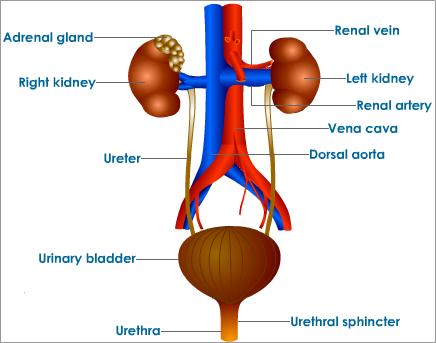
Human Excretory Organs

Excretion : 

 Removal of nitrogenous substances formed during metabolism from the body of human is called excretion. Normally excretion means the release of nitrogenous excretory substances like urea, ammonia, uric acid etc.
The main excretory organs of human are as follows –

(i) Kidneys

  • The main excretory organ in human and other mammals is a pair of kidneys. Its weight is 140 grams.
  • There are two parts of it. Outer part is called cortex and the inner part is called medulla.
  • Each kidney is made up of approximately 1,30,00000 kidney ducts which are called nephrons.
  • Nephron is the structural & functional unit of the kidney.
  • There is a cup like structure in the every nephron called Bowman's capsule.
  • Glomerulus of thin blood vessels are  found in the Bowman's capsule which is made up of two types of arterioles.
(i) Afferent arteriole : Which carries the blood to the glomerulus.
(ii) Efferent arteriole : By which the blood is taken out of the glomerulus.
  • The process of filtration of liquids into the cavity of Bowman's capsule, is called ultra filtration.
  • The main function of the kidneys is purification of blood plasma i.e. to excrete the unwanted nitrogenous waste substance through urination.
  • The supply of blood to kidneys takes place in large quantity in comparison to other organs.
  • In the kidneys average 125 ml per minute blood is filtrated i.e. 180 litres per day. Out of it 1.45 liters urine is formed daily and the remaining is absorbed back by the cells of nephron and mix into the blood.
  • In the normal urine there is 95% water, 2% salt, 2.7% urea and 0.3% uric acid.
  • The colour of the urine is light yellow due to the presence of urochromes in it. Urochrome is formed by the dissociation of haemoglobin.
  • Urine is acidic. Its pH value is 6.
  • The stone formed in the kidney is made up of calcium oxalate.
(ii) Skin : Oil gland and sweat glands found in the skin respectively secretes sebum and sweat.
(ii) Liver : Liver cells play the main role in excretion by converting more and more amino acids and ammonia of blood into urea.
(iii) Lungs : The lungs excretes two types of gaseous substances carbon dioxide and water vapour. The excretion of some substances like garlic, onion and some spices in which vapour component excreted by the lungs.

Tuesday, 31 January 2017

2017 Padma Awads


Padma Awards - one of the highest civilian Awards of the country, are conferred in three categories, namely, Padma Vibhushan, Padma Bhushan and Padma Shri.
📌 The Awards are given in various disciplines/ fields of activities, viz.- art, social work, public affairs, science and engineering, trade and industry, medicine, literature and education, sports, civil service, etc. ‘Padma Vibhushan’ is awarded for exceptional and distinguished service; ‘Padma Bhushan’ for distinguished service of high order and ‘Padma Shri’ for distinguished service in any field.
📌 The awards are announced on the occasion of Republic Day every year.
📌 These awards are conferred by the President of India at ceremonial functions which are held at Rashtrapati Bhawan usually around March/ April every year.
📌 This year the President of India has approved conferment of Padma Awards to 89 persons.
📌 The list comprises of 7 Padma Vibhushan, 7 Padma Bhushan and 75 Padma Shri Awardees. 
📌 19 of the awardees are women and the list also includes 5 persons from the category of foreigners, NRIs, PIOs and 6 Posthumous awardees.
➖➖➖➖➖➖➖➖➖➖➖➖➖➖
🇮🇳🇮🇳🇮🇳 PADMA VIBHUSHAN 🇮🇳🇮🇳🇮🇳
✔ Name▶▶▶Field ▶▶▶State ✔
Shri K J Yesudas ➡ Art-Music ➡ Kerala
Sadhguru Jaggi Vasudev ➡ Others-Spiritualism ➡ Tamil Nadu
Shri Sharad Pawar ➡ Public Affairs ➡ Maharashtra
Shri Murli Manohar Joshi ➡ Public Affairs ➡ Uttar Pradesh
Prof. Udipi Ramachandra Rao ➡ Science & Engineering ➡ Karnataka
Late Shri Sunder Lal Patwa (Posthumous) ➡ Public Affairs ➡ Madhya Pradesh            
Late Shri PA Sangma (Posthumous) ➡ Public Affairs ➡ Meghalaya
➖➖➖➖➖➖➖➖➖➖➖➖➖➖
🇮🇳🇮🇳🇮🇳 Padma Bhushan 🇮🇳🇮🇳🇮🇳
✔ Name▶▶▶Field ▶▶▶State ✔
              
Shri Vishwa Mohan Bhatt ➡ Art-Music ➡ Rajasthan
Prof. (Dr.) Devi Prasad Dwivedi ➡ Literature & Education ➡ Uttar Pradesh          
Shri Tehemton Udwadia ➡ Medicine ➡ Maharashtra
Shri Ratna Sundar Maharaj ➡ Others-Spiritualism ➡ Gujarat
Swami Niranjana Nanda Saraswati ➡ Others-Yoga ➡ Bihar
H.R.H. Princess Maha Chakri Sirindhorn (Foreigner) ➡ Literature & Education ➡ Thailand
Late Shri Cho Ramaswamy (Posthumous) ➡ Literature & Education –Journalism ➡ Tamil Nadu
➖➖➖➖➖➖➖➖➖➖➖➖➖➖
🇮🇳🇮🇳🇮🇳 Padma Shri 🇮🇳🇮🇳🇮🇳
✔ Name▶▶▶Field ▶▶▶State ✔
Smt. Basanti Bisht ➡ Art-Music ➡  Uttarakhand          
Shri Chemanchery Kunhiraman Nair ➡ Art-Dance ➡ Kerala
           
Smt. Aruna Mohanty ➡ Art-Dance ➡ Odisha
Smt. Bharathi Vishnuvardhan ➡ Art-Cinema ➡ Karnataka
Shri Sadhu Meher ➡ Art-Cinema ➡ Odisha
Shri T K Murthy ➡ Art-Music ➡ Tamil Nadu
Shri Laishram Birendrakumar Singh ➡ Art-Music ➡ Manipur
Shri Krishna Ram Chaudhary ➡ Art-Music ➡ Uttar Pradesh
Smt. Baoa Devi➡Art-Painting ➡Bihar
Shri Tilak Gitai➡Art-Painting ➡Rajasthan
Dr. Prof. Aekka Yadagiri Rao➡Art-Sculpture ➡Telangana
Shri Jitendra Haripal➡Art-Music ➡Odisha
Shri Kailash Kher➡Art-Music ➡Maharashtra
Smt. Parassala B Ponnammal➡Art-Music ➡Kerala
Smt. Sukri Bommagowda➡Art-Music ➡Karnataka
Shri Mukund Nayak➡Art-Music ➡Jharkhand
Shri Purushottam Upadhyay➡Art-Music ➡Gujarat
Smt. Anuradha Paudwal➡Art-Music ➡Maharashtra
Shri Wareppa Naba Nil➡Art-Theatre ➡Manipur
Shri Tripuraneni Hanuman Chowdary➡Civil Service➡Telangana
Shri T.K. Viswanathan➡Civil Service➡Haryana
Shri Kanwal Sibal➡Civil Service➡Delhi
Shri Birkha Bahadur Limboo Muringla➡Literature & Education➡Sikkim
Smt. Eli Ahmed➡Literature & Education➡Assam
Dr. Narendra Kohli➡Literature & Education➡Delhi
Prof. G. Venkatasubbiah➡Literature & Education ➡Karnataka
Shri Akkitham Achyuthan Namboothiri➡Literature & Education➡Kerala
Shri Kashi Nath Pandita➡Literature & Education➡Jammu & Kashmir
Shri Chamu Krishna Shastry➡Literature & Education➡Delhi
Shri Harihar Kripalu Tripathi➡Literature & Education➡Uttar Pradesh
Shri Michel Danino➡Literature & Education➡Tamil Nadu
Shri Punam Suri➡Literature & Education➡Delhi
Shri VG Patel➡Literature & Education➡Gujarat
Smt. V Koteswaramma➡Literature & Education➡Andhra Pradesh
Shri Balbir Dutt➡Literature & Education-Journalism➡Jharkhand
Smt. Bhawana Somaaya➡Literature & Education-Journalism➡Maharashtra
Shri Vishnu Pandya➡Literature & Education-Journalism➡Gujarat
Dr. Subroto Das➡Medicine ➡Gujarat
Dr. (Smt.) Bhakti Yadav➡Medicine ➡Madhya Pradesh
Dr. Mohammed Abdul Waheed➡Medicine ➡Telangana
Dr. Madan Madhav Godbole➡Medicine ➡Uttar Pradesh
Dr. Devendra Dayabhai Patel➡Medicine ➡Gujarat
Prof. Harkishan Singh➡Medicine ➡Chandigarh
Dr. Mukut Minz➡Medicine ➡Chandigarh
Shri Arun Kumar Sharma➡Others-Archaeology ➡Chhattisgarh
Shri Sanjeev Kapoor➡Others-Culinary ➡Maharashtra
Smt. Meenakshi Amma➡Others-Martial Art➡Kerala
Shri Genabhai Dargabhai Patel➡Others-Agriculture ➡Gujarat
Shri Chandrakant Pithawa➡Science & Engineering➡Telangana
Prof. Ajoy Kumar Ray➡Science & Engineering➡West Bengal
Shri Chintakindi Mallesham➡Science & Engineering➡Andhra Pradesh
Shri Jitendra Nath Goswami➡Science & Engineering➡Assam
Shri Daripalli Ramaiah➡Social Work➡Telangana
Shri Girish Bhardwaj➡Social Work ➡ Karnataka
Shri Karimul Hak➡Social Work➡West Bengal
Shri Bipin Ganatra➡Social Work➡West Bengal
Smt. Nivedita Raghunath Bhide➡Social work➡Tamil Nadu
Shri Appasaheb Dharmadhikari➡Social Work➡Maharashtra
Baba Balbir Singh Seechewal➡Social Work➡Punjab
Shri Virat Kohli➡Sports-Cricket ➡Delhi
Shri Shekar Naik➡Sports-Cricket ➡Karnataka
Shri Vikasa Gowda➡Sports-Discus Throw➡Karnataka
Smt. Deepa Malik➡Sports-Athletics ➡Haryana
Shri Mariyappan Thangavelu➡Sports-Athletics ➡Tamil Nadu
Smt. Dipa Karmakar➡Sports-Gymnastics ➡Tripura
Shri P R Shreejesh➡Sports-Hockey ➡Kerala
Smt. Sakshi Malik➡Sports-Wrestling ➡Haryana
Shri Mohan Reddy Venkatrama Bodanapu➡Trade & Industry➡Telangana
Shri Imrat Khan(NRI/PIO)➡Art-Music ➡USA
Shri Anant Agarwal(NRI/PIO)➡Literature & Education➡USA
Shri H.R. Shah(NRI/PIO)➡Literature & Education-Journalism➡USA
Late (Smt.) Suniti Solomon(Posthumous)➡Medicine ➡Tamil Nadu
Shri Asoke Kumar Bhattacharyya(Posthumous)➡Others-Archaeology ➡West Bengal
Dr. Mapuskar(Posthumous)➡Social Work➡Maharashtra
Smt. Anuradha Koirala (Foreigner)➡Social Work➡Nepal

Biology

Deoxyribo nucleic Acid (DNA) :

  • DNA stands for Deoxyribo nucleic Acid , it was discovered by Frederic Maischer.
  • DNA is a double stranded molecule made up of elongated chain of sub-units called nucleotides.
  • DNA is mainly found in nucleus and in small amount it is also found in mitochondria an chloroplast.
  • Chemically a nucleotide has three components.
(1) Nitrogenous base
(2) Pentose Sugar
(3) Phosphate group.
  • Nitrogenous  base are of two type i.e.Purine & Pyrimidines. 
  • Purines contain two nitrogen base i.e. Adinine and Guanine.
  • Pyrimidine nitrogen base are Thymine and Cytosine, thus there are four kinds of nucleotide present in DNA i.e. Adinine, Guanine, Thymine, Cytosine.

Structure of DNA:

  • Watson and Crick give the structural model of DN
  • DNA molecule is consists of two polynucleotide strand, forming a double helix structure.
  • Each strand has a backbone of sugar and phosphate, nitrogen base is attached to the sugar.
  • Two strands are joined together by hydrogen bonds between the bases.
  • Adenine pairs with thymine whereas guanine pairs with cytosine.
  • Adenine and thymine are complementary to each other and cytosine is complementary to guanine.

Function of DNA:

  • DNA is genetic material and contains genetic information in coded form.
  • DNA has two main function replication and expression.

2.Ribonucleic Acid (RNA) : 

  • RNA stands for Ribonucleic acid.
  • RNA is single stranded nucleic acid made up of phosphate, ribose sugar and nitrogen base uracil, adinine, guanine and cytosine.
  • It is found in nucleus as well as cytoplasm.
  • Its main function is to synthesis the protein.
  • RNA is of three kind.
    1.Messenger RNA (mRNA): It brings the massage from DNA found in the nucleus to cytoplasm in the coded          form.
     2.Ribosomal RNA (rRNA): Present in ribosome which is the site of protein synthesis.
     3.Transfer RNA (t RNA): It is the carrier of amino acid and transfers it to the ribosome.
Difference between RNA and DNA
DNA & RNA

3.Virus:

  • Virus was discovered by Russian Scientist Iavanosky during the test of Mosaic disease in Tobacco.
  • Virus acts as a link between the living and non-living.
  • Virus is dead but when it comes in contact with the living cell it gets activated.
  • ‘The virus in which RNA  is found as the genetic material are called Retrovirus.
  • Virus is of three types:
  1. Plant Virus: RNA is present as its nucleic acid
  2. Animal Cell: DNA and sometimes RNA is found in it.
  3. Bacteriophage: They kill the bacteria e.g. T-2 phage.

4.Bacteria:

  • Bacteria was discovered by Antony von Lecuwenhoek and its study is known as bacteriology.
  •  Bacteria is of different types on the basis of shape:
  1. Bacillus: This is a rod like or cylindrical.
  2. Round or Cocus: These are round and smallest bacteria.
  3. Comma shape or vibrio
  4. Sprillum: Spring or Screw shaped.
  • Anabaena and Nostoc cyanobacteria fixed the atmospheric nitrogen into soil.

Optics


LIGHT

  • Light is a form of energy, which is propagated as electromagnetic wave.
  • It is the radiation which make our eyes able to 'see the object. Its speed is 3 x 10⁸ m/s. It is the form of energy. It is a transverse wave.
  • It takes 8 min 19s to reach on the earth from the sun and the light reflected from moon takes 28s to reach earth.
  • When light falls on the surface of an object it can either be
  1. Absorbed - If an object absorbs all the light falling on it , then it will appear perfectly black for example a blackboard
  2. Transmitted - An object is said to transmit light if it allows light to pass through itself and such objects are transparent.
  3. Reflected - If an object sends back light rays falling on its surface then it is said to have reflected the light

Reflection of Light

  • When a ray of light falls on a boundary separating two media comes back into the same media, then this phenomenon is called reflection of light.

Laws of Reflection of light

  1. The angle of incidence is equal to the angle of reflection, and
  2. The incident ray, the reflected ray and the normal to the mirror at the point of incidence all lie in the same plane.

Reflection from Plane Mirror

  • If an object moves towards a plane mirror with speed v, relative to the object the moves towards it with a speed 2v.
  • To see his full image in a plane mirror, a person required a mirror of at least half of his height.

Refraction of Light

  • The phenomenon of deviation of light rays from its path when it travels from one transparent medium to another medium is called refraction of light.
  • The cause of refraction is due to the different speed of light in different medium.
  • When a ray of light enters from one medium to other medium, its frequency and phase do not change, but wavelength and velocity change.
  • Due to refraction form Earth's atmosphere, the stars appear to twinkle.

Laws  of Refraction:

  • The incident ray, the refracted ray and the normal at the point of incidence all three lie in the same plane.
  • The ratio of sine of angle of incidence to the sine of angle of refraction remains constant for a pair  of media i.e.
Sin i/Sin r  = constant=μ2/μ1,  this law is known as snell's law

Application of Refraction:

  • When light travels from a denser medium towards  a rarer medium it deviates away from the normal , therefore a pond appear shallower.
  • A coin appears at lesser depth in water.
  • Writing on a paper appears lifted when a glass slab is placed over paper.

Critical Angle:

  • The angle of incidence in a denser medium for which the angle of refraction in rarer medium becomes 90°, is called the critical angle.

Total Internal Reflection:

When a light ray travelling from a denser medium to the rarer medium is incident at the interface at an angle of incidence greater than critical angel, then light rays reflected back into the denser medium , this phenomenon is known as total internal reflection
Sparkling of diamond, mirage and looming, shinning of air bubble in water and optical Fibre are examples of total internal reflection.

Spherical Mirror:

Spherical mirror are of two types
  1. Concave mirror
  2. Convex mirror
  • Image formed by a convex mirror is always virtual, erect and diminished.
  • Image formed by a concave mirror is generally real and inverted.
Uses of Concave Mirror
  • As a shaving mirror
  • As a reflector for the head lights of a vehicle, search light
  • In ophthalmoscope to examine eye, ear, nose by doctors.
  • In solar cookers.
Uses of Convex Mirror
  • As a rear view mirror in vehicle because it provides the maximum rear field of view and image formed is always erect.
  • In sodium reflector lamp.
Important points related to spherical Mirrors:
Centre of Curvature (c): The centre of the hollow glass sphere of which the mirror is a part.
Radius of Curvature(R): The radius hollow sphere of which the mirror is a part.
Pole(P): The mid-point of a spherical mirror is called pole.
Focus (F): when a parallel beam of light rays is incident on a spherical mirror then after reflection it meets or appears to meet at a point on principal axis, called focus of the spherical mirror.
Focal length(f): 
Focal length d= R/2
concave mirror


convex mirroe

Lenses :

A lens is a uniform refracting medium bounded by two spherical surface or one plane surface.

Lenses are of two types:

  • Convex lens
  • Concave lens

Prism :

Prism is a uniform transparent refracting medium bounded by plane surfaces inclined at some angles forming a triangular shape.
Dispersion of light:
When a light is incident on a glass prism, it splits into its seven colour comonents in the following sequence VIBGYOR,  and this is known as dispersion of white light.
The refractive index of glass is maximum for violet colour and minimum for red colour of light, therefore violet colour of light deviated maximum and red colour of light deviated least.


Motion

Scalar Quantities: 

 Physical quantities which have magnitude only and no direction are called scalar quantities.
Example: Mass, speed, volume, work, time, power, energy etc.

Vector Quantities: 

Physical quantities which have magnitude and direction both and which obey triangle law are called vector quantities.
Example: Displacement, velocity, acceleration, force, momentum, torque etc.
Electric current, though has a direction, is a scalar quantity because it does not obey triangle law.
Moment of inertia, pressure, refractive index, stress are tensor quantities.

Distance: 

Distance is the actual path traveled  by a body in a given period of time.

Displacement:

  • The change in the position of the object in a given period of time
  •  Distance is a scalar quantity whereas displacement is a vector quantity both having the same unit (metre)
  •  Displacement may be positive, negative or zero whereas distance is always positive.

Speed:

  • Distance travelled by the moving object in unit time interval is called speed i.e. speed = Distance/ Time
  • It is a scalar quantity and its SI unit is metre/second (m/s).
  • Speed of an object at any instant is called instantaneous speed.
  • An object is said to be traveled with non-uniform speed if it covers unequal distance in equal interval of time.

Velocity:

  •  Velocity of a moving object is defined as the displacement of the object in unit time interval i.e., velocity =
  • It is a vector quantity and its SI unit is metre/second.
  • If a body goes equal displacement in equal interval of time then it is called uniform velocity.
  • If a body undergoes unequal displacement in equal interval of time then it is called variable velocity.
Relative velocity
= V1 +V2 if two travels in opposite direction
=V1-V2 if two travels in same direction

Acceleration:

  • Acceleration of an object is defined as the rate of change of velocity of the object .
  • It is a vector quantity and its SI units is metre/second2 (m/s2)
  • If velocity decreases with time then acceleration is negative and is called retardation.
  • If acceleration does not change with time it is called constant acceleration.
  • Some equation of acceleration;
          V=u+at
         S=ut+at2/2
        V2= u2+2as
Here v=final velocity, u is initial velocity, t is time ineterval, a is acceleration and s is the distance travel.

Circular Motion:

  • The motion of an object along a circular path it is called circular motion.
  • If the object moves with uniform speed, its motion is uniform circular motion.
  • Uniform circular motion is an accelerated motion because the direction of velocity changes continuously.

Angular Displacement and Velocity:

The angle subtended at the centre of a circle by a body moving along the circumference of the circle is called angular displacement of the body. It unit is radian.
Angular displacement= length of arc/radius of circle
Time rate of change of angular displacement is called angular velocity.
It is generally denoted by ω and image004

Force:

  • Force is that external cause which when acts on a body changes or tries to change the initial state of the body.
  • Its SI unit is Newton(N).
  • A body is said to be in equilibrium if the sum of all the forces acts on the body is Zero.
  • Nuclear force is the strongest force.

Momentum:

  •  Momentum is the property of a moving body and is defined as the product of mass and velocity of the body i.e.
  •           Momentum = mass x velocity.
  • It is a vector quantity. Its SI unit is kgm/s.

Newton’s Law:

Newton first law

If no external force acts on a body then it remains in the same state of rest or motion that is in its present state.

Inertia of Rest:

  • Inertia is the property of a body by virtue of which it opposes any change in its state of rest or of uniform motion.
  • When a bus or train at rest starts to move suddenly the passengers sitting in it feels jerk in backward direction due to inertia of rest.
  • Dust particle come out of a carpet if we beat it with stick.
  • A passenger jumping out of a train is advised to jump in the direction of bus and ran for a short distance.

Inertia of Motion:

When a running bus or train stops suddenly, the passengers sitting in it jerk in forward direction due to inertia of motion.

Newton's second law of motion:

  • The rate of change in momentum of a body is directly proportional to the applied force on the body and takes place in the direction of force.
If F = force applied, a = acceleration produced and m = mass of body
then F = ma.

Newton's Third Law of Motion : 

To every action, there is an equal and opposite reaction.
Examples of third law –
  • Recoil of a gun
  • Motion of rocket
  • While drawing water from the well, if the string breaks up the man drawing water falls back.
Centripetal Force:
When a body is in circular motion, a force always acts on the body towards the centre of the circular path, this force is called centripiatl force
If a body of mass m is moving on a circular path of radius R with uniform speed v, then the required centripetal force

Centrifugal Force:

  • Centrifugal force is such a pseudo force.
  • It is equal and opposite to centripetal force.
Application of centripetal and Centrifugal forces:
  • Roads are banked at turns to provide required centripetal force for taking a turm.
  • Cream is separated form milk when it is rotated in a vessel about the same axis.
  • Gravitational force of attraction between earth and sun acts as centripetal force.
  • Orbital motion of electrons around the nucleus
  • Cyclist inclined itself from vertical to obtain required centripetal force.

Principle of conservation of linear momentum:

  • If no external force acts on a system of bodies, the total linear momentum of the system of bodies remains constant.
  • As a consequence, the total momentum of bodies before and after collision remains the same.
  • As in case of rocket, ejecting gas exerts a forward force which helps in accelerating the rocket in forward direction.

Impulse:

  • When a large force acts on a body for very small time, then force is called impulsive force.
  • Impulse is defined as the product of force and time.
  • Impulse = force x time = change in momentum.
  • It is a vector quantity and its direction is the direction of force. Its SI unit is newton second (Ns).

Friction:

It is force which acts on a body when two body are in contact and one tries to move over other.
Types of Friction:
Static Friction:
The opposing force which acts on acts on a body when it tries to move over the other but actual motion has yet not started.
Limiting friction:
It is the force that comes to play, when a body is at the verge of moving over the other body.
Kinetic Friction:
This is the opposing force that comes to play when one body actually moves over the surface of another body is called kinetic friction. It is of two types which are as follows:
Sliding Friction: When a body slides over the surface of other
Rolling Friction: When a body rolls over the surface of another body
  • It is easier to roll a body than to slide because the sliding friction is greater than the rolling friction.
  • It is easy to drive a bicycle when its  tyres are fully inflated because it decreases rolling friction.
Application of Friction:
  • A ball bearing is used to reduce the rotational friction.
  • Friction is necessary for walking and to apply breaks in vehicles.
  • When a pedal is applied to a bicycle, the force of friction on rear wheel is in forward direction and on front wheel it is in the backward direction.
  • Friction can be reduced by applying the polishing or applying any lubricants.
  • The tyre are made up of synthetic rubber because its coefficient of friction with road is larger and stops sliding the bicycle.

Gravitation and Satellite

Gravitation:

Each and every massive body attracts each other by virtue of their masses. This phenomenon is called gravitation.

Newton’s law of Gravitation.

The gravitational force of attraction between two bodies is directly proportional to the product of their masses and inversely proportional to the square of the distance between them.
Gravitational force (F)=Gm1m2/ r 2
  • Where G is the gravitational constant its value is 6.67×10⁻¹¹ Nm2kg-2.
  • m1, m2 are the mass of two bodies and r is the distance between them.
  • Gravitational force is central as well as conservative force.

Acceleration Due to Gravity of Earth:

  • The acceleration produced in a body due to the gravitational pull of earth is called acceleration due to gravity.
g=GM/R2  where M is the mass of earth and R is the radius of earth.
  • The value of g changes slightly changes from place to place but its value near the earth’s surface is 9.8ms-2.
  • Gravitational force is the weakest force in nature.

Condition affecting the value of g:

  • Shape of Earth: Earth shape also affect the value of acceleration due to gravity that’s why g is maximum at poles and minimum at the equator.
  • Rotation of Earth on its axis:
  • Effects of Altitude: The value of g decreases with the increase in height.
  • Effects of depth: The value of g decreases with depth and become zero at the centre earth.

Mass and Weight:

  • The mass of a body is the quantity of matter contains in it and it is a scalar quantity and its SI unit is Kg.
  • Mass of a body does not change from place to place.
  • The weight of the body is the force with which it is attracted towards the centre of earth and it is given by w=mg.
  • Weight of the body is a vector quantity and its unit is Newton
  • The centre of gravity of a body is that point at which whole weight of the body appears to act.
  • Weight of the body is a variable quantity and it changes from place to place.

Weight of a body in a lift:

  • When lift is at rest or in uniform motion then apparent weight is equal to the real weight of the body, w=mg.
  • When lift is accelerating upward then apparent weight is greater than the real weight of the body i.e. w=m(g+a)
  • When lift is accelerating downward then apparent weight of the body is less than the real weight of the body i.e. w=m(g-a).
  • When lift is falling freely under gravity the apparent weight of the body is zero i.e.
          W=m(g-g) as a =g
         w=0
  • Weight of the body on moon is lesser than the weight of the body on earth as the acceleration due to gravity at the moon is less than the acceleration due to gravity on earth.  Acceleration due to gravity on Earth is 6 times than that of on the moon.

Planets:

  • Planets are the heavenly bodies which  revolves around the sun in a specific orbit or path.
  • Our solar system contains eight planets as Pluto losses its planet status.

Kepler’s Laws of Planetary Motion:

Kepler gives three laws which are as follows:
  • All planets revolve around the sun in elliptical orbits with the sun at its one focus.
  • The areal speed of planet around the sun is constant.
  • The square of the time period of revolution of a planet around the sun is directly proportional to the cube of the semi-major axis of its elliptical orbit

Satellite:

  • A heavenly body revolving around a planet in an orbit is called a satellite.
  • Moon is the natural satellite of the earth.
There are two types of artificial satellites:

Geostationary Satellite:

  • It revolves around the earth in equatorial orbits which is also called Geostationary or Geosynchronous orbit.
  • They revolve around the earth at the height of  36000 Km
  • There period of rotation is same as the earth’s time period of rotation around its own axis i.e. 24 hours.
  • These satellites appear to be stationary.

Polar Satellite:

These satellites revolve around the earth in polar orbits at a height of around 800 km.
The time period of rotation of these satellite is 84 minutes.

Period of Revolution of a satellite:

  • Time taken by a satellite to complete one revolution in its orbit is called its period of revolution.
  • Period of revolution= Circumference of orbit/ orbital speed
  • Period of revolution of a satellite depends upon the height of satellite from the surface of earth, greater its height from earth surface more will be its period of revolution.
  •  Period of revolution is independent of its mass.

Escape Velocity:

  • The minimum velocity with which when an object is thrown vertically upwards from the earth’s surface just crosses the earth’s gravitational field and never returns.
  • Escape velocity=(2gr)1/2
  • Its value on earth surface is 11.2 km/sec
  • When orbital speed is is increased by 41% i.e √2 times then it will escape from its orbit.

Atomic and Nuclear Physics

Cathode Rays

Cathode rays, discovered by Sir William Crooke and its properties are
  • travel in straight lines.
  • Produce fluorescence.
  • can penetrate through thin foils of metal and deflected by both electric and magnetic fields.
  • have velocity ranging 1/30th to 1/10th of the velocity of light.

Positive or Canal Rays

  • These rays were discovered by Goldstein.
  • The positive ray consists of positively charged particles.
  • These rays travel in straight line.
  • These rays are deflected by electric and magnetic fields.
  • These rays can produce ionization in gases.

X-Rays

  • X-rays are electromagnetic waves with wavelength range 0.1 A-100 A.
  • X-rays were discovered by Roentgen.
  • X-rays travels in straight line.
  • Long exposures of X – rays in injurious for human body.
  • X – rays shows photoelectric effect.
Uses of X-Rays
  • In medical sciences X-rays are used in surgery for the detection of fracture, diseased organs, foreign matter like bullet, stones etc. They are used in treatment of cancer and in skin diseases.
  • In Engineering, X-rays are used in detecting faults, cracks, flaws and gas pockets in the finished metal products and in heavy metal sheets.
  • In Scientific Work, X-rays are used in studying crystal structure and complex molecules.
  • In Custom Department X-rays are used in custom department for detection of banned materials kept hidden.

Radioactivity

  • Radioactivity was discovered by Henry Becquerel, Madame Curie and Pierre Curie for which they jointly won Nobel Prize.

Nuclear Fission

  • Atom Bomb is based on nuclear fission. U235 and Pu239 are used as fissionable material.
  • Nuclear fission was first demonstrated by Halin and Fritz Strassmann.

Nuclear Fusion

  • When two or more light nuclei combined together to form a heavier nucleus is called as nuclear fusion.
  • For the nuclear fusion, a temperature of the order of 108 K is required.
  • Hydrogen Bomb was made by the American Scientist in 1952. This is based on nuclear fusion. It is 1000 times more powerful than atom bomb.

Nuclear Reactor or Atomic Pile

  • Nuclear reactor is an arrangement, in which controlled nuclear fission reaction takes place.
  • First nuclear reactor was established in Chicago University under the supervision of Prof Enrico Fermi.
  • Heavy water, graphite and beryllium oxide are used to slow down the fast moving neutrons. They are called moderate.
Uses of Nuclear Reactor
(i)To produce electrical energy from the energy released during fission.
(ii)To produce different isotopes, this can be used medical, physical and agriculture science.
There are several components of nuclear reactor which are as follows:
  • Fissionable Fuel U235 or U239 is used.
  • Moderator decreases the energy of neutrons, so that they can be further used for fission reaction.
  • Heavy water and graphite are used as moderator.
  • Control Rod rods of cadmium or boron are used to absorb the excess neutrons produced in fission of uranium nucleus, so that the chain reaction.